Salary Negotiation Script & Worksheet
Use the online edition, print the PDF, or download the working materials below.
By Vernon J. DeFlanders Sr. · Updated November 9, 2026
Prepare for salary negotiation
Prepare for salary negotiation by gathering evidence about the role, your experience and the offer. This worksheet helps you compare pay, benefits and alternatives before making a clear request. Use truthful examples and decide what you will do if the employer declines.
For related practical resources, explore the Career pathway.
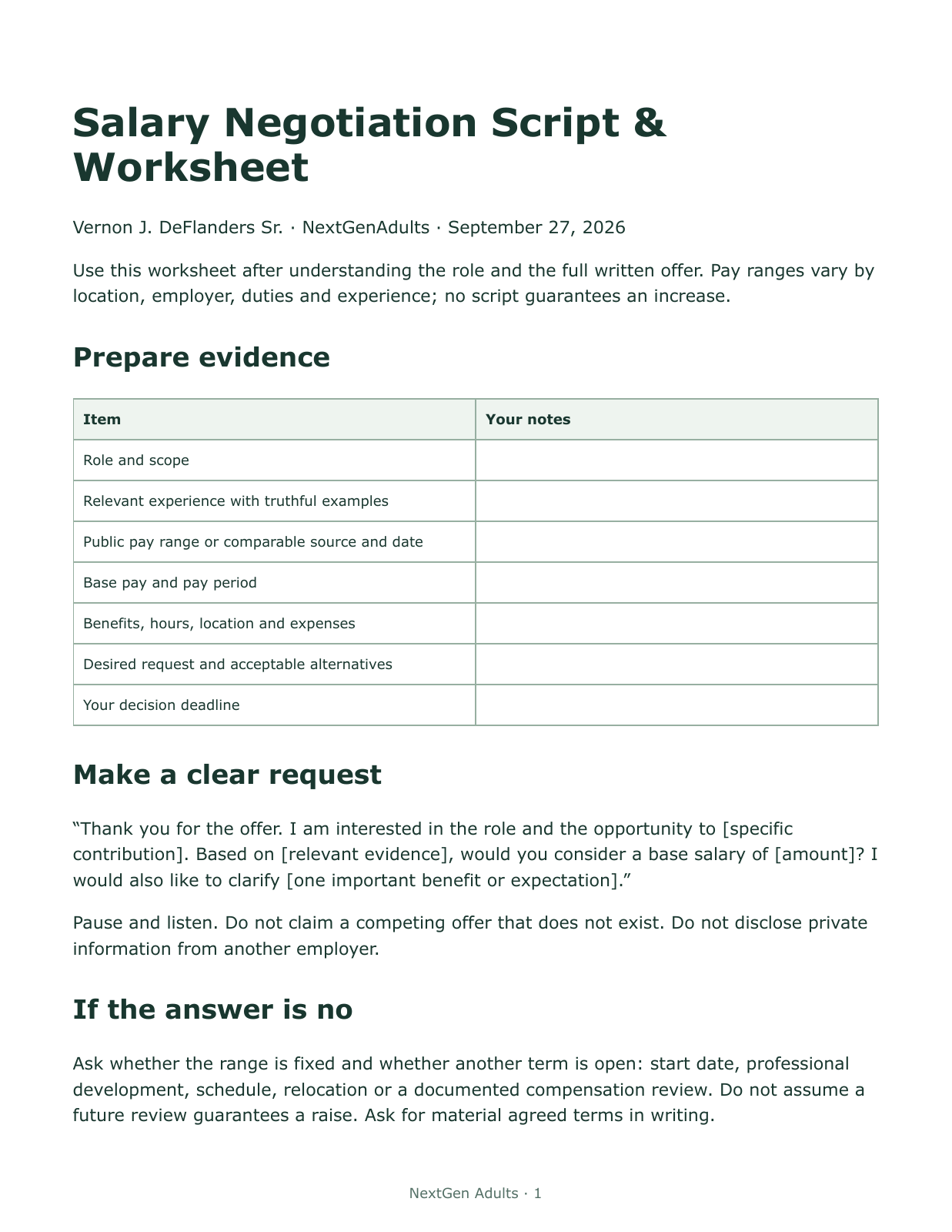
Use this worksheet after understanding the role and the full written offer. Pay ranges vary by location, employer, duties and experience; no script guarantees an increase.
Evidence for salary negotiation
| Item | Your notes |
|---|---|
| Role and scope | |
| Relevant experience with truthful examples | |
| Public pay range or comparable source and date | |
| Base pay and pay period | |
| Benefits, hours, location and expenses | |
| Desired request and acceptable alternatives | |
| Your decision deadline |
Make a clear request
“Thank you for the offer. I am interested in the role and the opportunity to [specific contribution]. Based on [relevant evidence], would you consider a base salary of [amount]? I would also like to clarify [one important benefit or expectation].”
Pause and listen. Do not claim a competing offer that does not exist. Do not disclose private information from another employer.
If the answer is no
Ask whether the range is fixed and whether another term is open: start date, professional development, schedule, relocation or a documented compensation review. Do not assume a future review guarantees a raise. Ask for material agreed terms in writing.
Compare the actual offer
Subtract unavoidable work costs from your take-home estimate. Consider commute, schedule, insurance and stability. An attractive headline salary may not fit your needs. Give yourself time to read the final written offer before accepting.
Practice a salary negotiation conversation
Write your opening sentence, one evidence example, one question and your response to a refusal. After the conversation, record the agreed terms and remaining questions.
U.S. Bureau of Labor Statistics Occupational Outlook Handbook provides broad occupation context, not a personalized salary quote.
Research occupation and pay information
The Bureau of Labor Statistics describes occupations, typical preparation and pay information; use it as context rather than an individual salary promise. See Occupational Outlook Handbook for the source guidance.