Navigating Student Loans and Debt
Use the online edition, print the PDF, or download the working materials below.
By Vernon J. DeFlanders Sr. · Updated November 9, 2026
Organize student loans before comparing options
Student loans need a current record before you compare repayment choices. This guide helps you separate loan types, understand terms and prepare questions for your servicer. Use official information for your own loans rather than relying on an old list of programs.
For related practical guidance, visit Money guidance.
Student loans guidance
Federal repayment guidance is the place to check currently available options for your federal loans; private loan terms come from your lender and agreement. See Federal repayment guidance.
Start with your actual loan records, not an old program list. This guide helps you organize the facts, compare options and ask useful questions. Repayment availability and rules change; verify the options shown for your loans through official sources before applying.
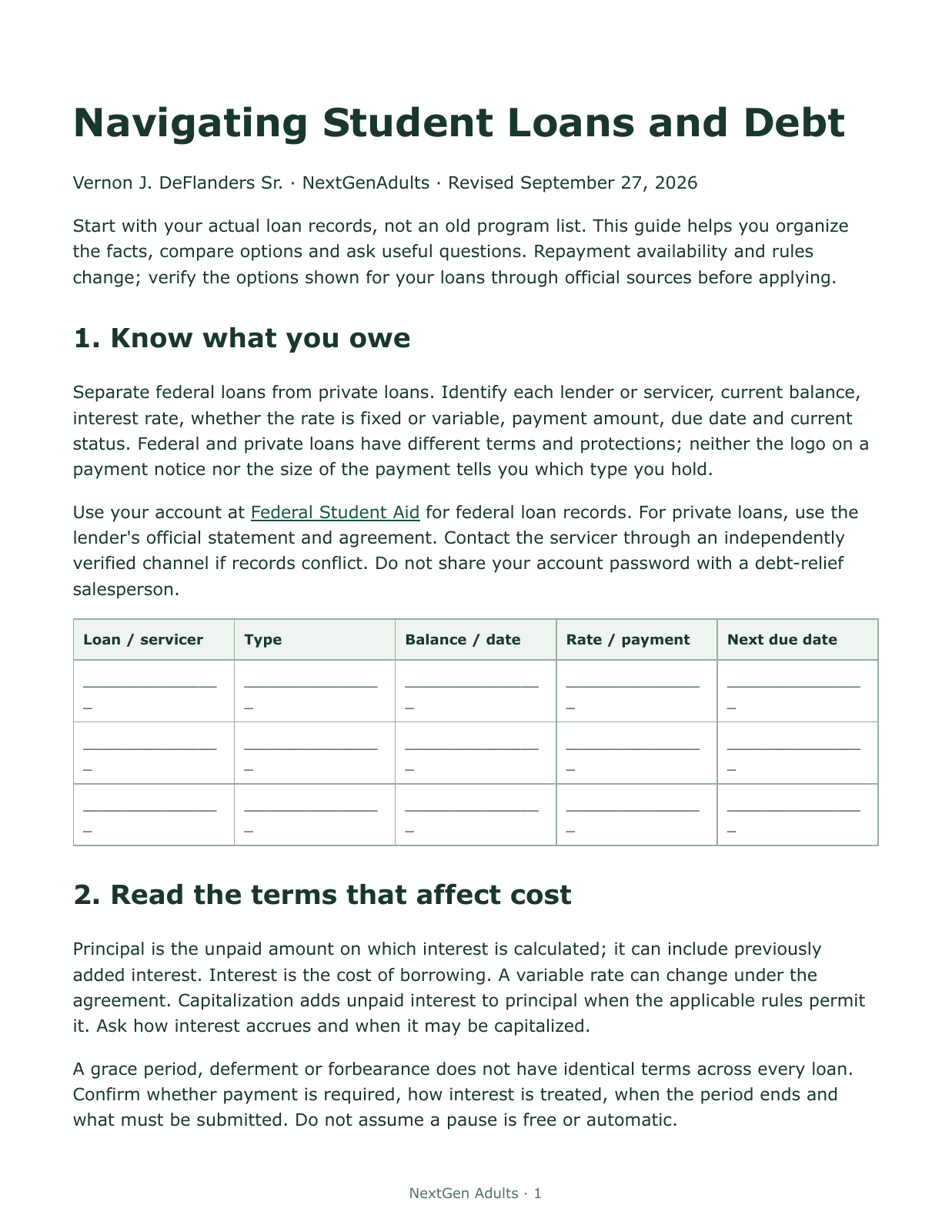
1. Know what you owe on student loans
Separate federal loans from private loans. Identify each lender or servicer, current balance, interest rate, whether the rate is fixed or variable, payment amount, due date and current status. Federal and private loans have different terms and protections; neither the logo on a payment notice nor the size of the payment tells you which type you hold.
Use your account at Federal Student Aid for federal loan records. For private loans, use the lender's official statement and agreement. Contact the servicer through an independently verified channel if records conflict. Do not share your account password with a debt-relief salesperson.
| Loan / servicer | Type | Balance / date | Rate / payment | Next due date |
|---|---|---|---|---|
| ________________ | ________________ | ________________ | ________________ | ________________ |
| ________________ | ________________ | ________________ | ________________ | ________________ |
| ________________ | ________________ | ________________ | ________________ | ________________ |
2. Read the terms that affect cost
Principal is the unpaid amount on which interest is calculated; it can include previously added interest. Interest is the cost of borrowing. A variable rate can change under the agreement. Capitalization adds unpaid interest to principal when the applicable rules permit it. Ask how interest accrues and when it may be capitalized.
A grace period, deferment or forbearance does not have identical terms across every loan. Confirm whether payment is required, how interest is treated, when the period ends and what must be submitted. Do not assume a pause is free or automatic.
3. Fit payments into a realistic budget
Use take-home income and essential living costs. Include required payments on every debt and a workable cash buffer. If income is irregular, plan from a conservative amount rather than your best month. Check the dates money arrives against the dates payments leave.
Automatic payment can help with scheduling, but monitor the funding account and verify posting. Ask the servicer whether a discount applies and under what conditions. Never rely on a scheduled debit as proof that payment succeeded.
4. Compare repayment choices for student loans
For federal loans, review Federal Student Aid's current repayment information and the options available for your loan type. For private loans, ask the lender which modifications or hardship arrangements it actually offers. A plan described in an older guide may no longer be available to you.
Compare monthly payment, total projected cost, repayment term, income-documentation requirements and any forgiveness conditions. A smaller payment may mean a longer term and greater total interest. Estimates depend on assumptions; record what those assumptions are and revisit them if income or rules change.
| Option verified with provider | Payment / term | Estimated total cost | Conditions / lost benefits | Decision or question |
|---|---|---|---|---|
| ________________ | ________________ | ________________ | ________________ | ________________ |
| ________________ | ________________ | ________________ | ________________ | ________________ |
5. Consolidation is different from refinancing
Federal consolidation combines eligible federal loans through a federal process. Private refinancing replaces debt with a private loan. Refinancing federal debt privately removes access to federal protections and federal repayment or forgiveness options for that debt. A lower advertised rate alone is not enough to decide.
Before either action, ask what happens to the rate, term, unpaid interest, payment history, eligibility and borrower protections. Obtain the answers in writing and read Federal Student Aid's consolidation guidance.
6. Extra payments and other debts
Keep all required payments current before directing extra money to one balance. A highest-interest-first approach can reduce interest costs under comparable terms; a smallest-balance-first approach may feel easier to sustain. Consider essential cash needs, fees and any verified forgiveness strategy as well as the rate.
Ask how extra payments are applied and whether the servicer will advance a due date. Confirm your instructions and check the next statement. Do not assume the entire extra amount went to principal if fees or accrued interest were outstanding.
7. If you cannot afford the next payment
- Contact the official servicer before the due date if possible.
- Explain the affordability problem and ask what current options apply to your loan.
- Ask about interest, total cost, duration, documentation and the end date of any temporary arrangement.
- Record the conversation, reference number, written confirmation and next required action.
- Confirm approval and payment instructions; submitting a request is not proof that payments are paused.
If you cannot resolve a servicing problem, use the CFPB's student loan help and complaint resources.
8. Forgiveness and discharge questions
Do not assume employment in a public-service role or a low income automatically qualifies a loan for forgiveness. Check the specific loan, employer, payment and application conditions of any current program through Federal Student Aid. Keep confirmation and records. Ask about tax consequences under the rules applicable when a balance is discharged; do not assume every discharge is tax-free.
Avoid anyone promising guaranteed forgiveness for an upfront fee. Use official application routes and verify claims before giving access to personal information.
Your next action
My most urgent question: ____________________
Official source or servicer contact: ____________________
Document needed: ____________________ Deadline: ____________________
Written answer received / next review date: ____________________
Reviewed September 27, 2026. This is general education, not a personalized repayment recommendation.