Free interactive tool

Budget Calculator

Use the budget calculator to compare monthly take-home income with expenses and planned savings, then see what remains. The 50/30/20 guideline offers a reference point for that plan.

Your numbers

Budget calculator: enter one monthly plan

Use monthly after-tax amounts. Blank fields count as $0. Put debt payments, insurance and any costs not listed below in Other. Count each bill once, including rent and utilities together under Housing. Enter savings separately; it is included in Total out.

Your result

Your budget calculator summary

Income
$0
Total expenses
$0
Savings
$0
Total out
$0
Remaining
$0
A useful reference

50 / 30 / 20 comparison

This common guideline suggests 50% for needs, 30% for wants, and 20% for savings. It is a starting point, not a requirement.

Needs and wants below are guideline targets, not a classification of your entries. Other bills and spending can include both essential costs and discretionary spending.

Needs (50%)Enter income to compare
$0
Wants (30%)Enter income to compare
$0
Savings (20%)Enter income to compare
$0

For educational planning only; this is not financial advice.

Use the result

Use your budget calculator result.

The calculator shows the current monthly picture; it does not decide what matters most. Review essential bills first, choose one pressure point to improve, and return when the numbers change.

A negative Remaining amount means the expenses and savings you entered exceed income. It describes this plan, not your bank balance. Check missing or repeated costs before adjusting a category.

For example, if an expense changes each month, start with a recent bill and note that it is an estimate. Include occasional costs in your monthly plan so a quiet month does not hide them. After using the budget calculator, compare the plan with actual spending and update it when your income or bills change.

For example, money left over may already have a job: a bill due next month, a repair, or a savings goal. Before treating it as spending money, check what the budget calculator does not include. Then choose one number to confirm and one action to take.

For a paper starting point, use the federal consumer.gov budget worksheet to list income and expenses.

See a fictional monthly budget
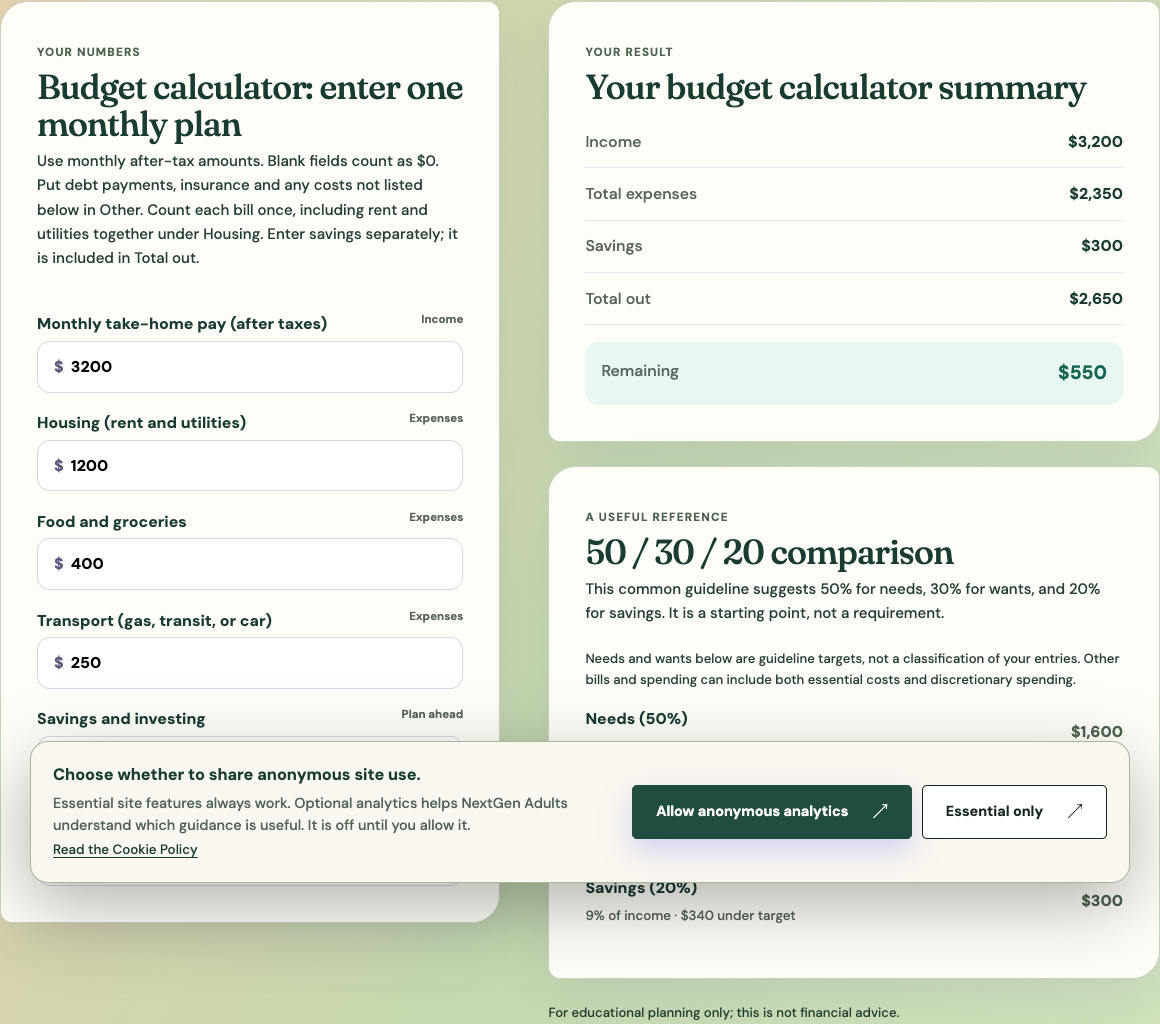
Budget example with $3,200 income, $2,350 expenses, $300 savings, and $550 remaining.
Fictional example from this calculator: $3,200 monthly take-home income; $1,200 housing; $400 food; $250 transport; $300 savings; and $500 other spending. Expenses plus savings total $2,650, leaving $550. Savings is counted once in Total out. Enter your own figures in the live calculator; this example is not a suggested spending plan.
The Next Step · Twice monthly · Optional

Put the result into perspective.

Twice-monthly guidance on one everyday decision, one practical action and a NextGen Adults tool.